As an Amazon Associate, we earn from qualifying purchases. Some links on this site are affiliate links at no extra cost to you. Our recommendations are based on thorough research and editorial judgment.

How Do I Pop Up Faster?

To pop up faster while surfing, we should focus on key techniques. First, we’ll guarantee ideal hand placement directly under our chest for stability. Timing is critical; we need to observe the wave and pop up at the right moment to avoid nose-diving. Strength and agility exercises, like resistance training and quick acceleration drills, build the necessary power. Finally, engaging our core helps maintain balance. By improving these areas, we can enhance our overall pop-up proficiency and effectiveness. For more strategies, we’ll explore specific drills and coaching tips.
Key Takeaways
- Position hands directly under your chest for a strong base, or stagger them slightly for enhanced projection toward the board’s nose.
- Observe waves carefully to time your pop-up at the right moment, avoiding nose-diving by staying in the top third of the wave.
- Engage in regular strength and conditioning exercises, focusing on leg strength and core stability to support quicker pop-ups.
- Practice pop-up drills consistently to improve neuromuscular coordination and timing, leading to faster execution.
- Seek coaching and utilize video analysis for immediate feedback and refinement of your technique, promoting continuous improvement.
Optimal Hand Placement for Speed
You may be interested



When we discuss ideal hand placement for speed during a pop-up, it’s essential to reflect on how our hands interact with the surfboard. Proper hand alignment is vital; placing our hands directly under the chest provides a strong base, facilitating a smooth shift into a standing position.
We should avoid positioning our hands too far forward or back, as this affects our balance and speed. Instead, a staggered hand placement, with the front hand slightly ahead, enhances our chest projection toward the board’s nose. This not only increases space for foot placement but also optimizes our ability to engage the rails effectively. By ensuring our hands are correctly aligned, we can achieve a faster and smoother pop-up, improving our overall surfing performance. Additionally, using a board with stability features can further enhance your confidence and speed during the pop-up process.
Timing Your Pop-Up With Wave Positioning

To successfully time our pop-up with the wave’s position, we must remain aware of the wave’s movements and changes. Effective wave observation is essential; by tracking the lip line, we can identify critical timing cues. Popping up too early or too late can lead to missed opportunities.
We should focus on the wave’s face and avoid staring at our boards. Positioning ourselves in the top third of the wave face maximizes our chances of catching momentum, while popping up at the right moment prevents nose-diving. Additionally, understanding the variety of breaks at popular surfing spots like Gold Coast can help us anticipate the wave behavior better.
Recommended Products
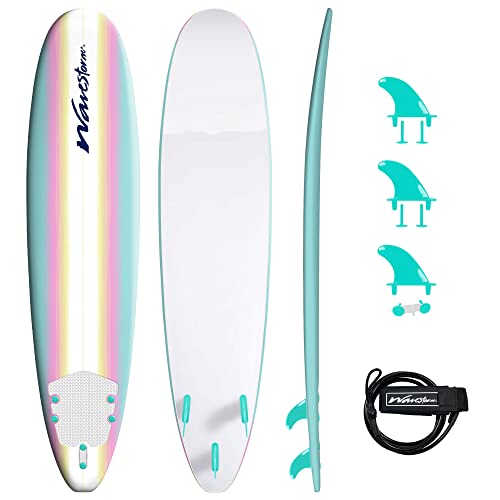
Soft Foam Construction Classic Surfboard, strong EPS core with 3 stringer system

the wavestorm 7ft surfboard dimensions are 7' x 22" w x 3" thick - weight is 10.2lbs - volume at 70 liters

How to Choose the Wakesurf Board: Regardless of your experience level, you’re sure to enjoy the WOOWAVE wakesurf board with its quality, and 2 fin setup. It has a beautiful design, is very stable, and is easy to use, making it a great first board. Is great for individuals who weigh more than 150 lbs and is a favorite due to its quality and versatility
Strength and Conditioning for Faster Pop-Ups
To boost our acceleration, we should regularly include acceleration drills that simulate quick shifts from lying down. Alongside, resistance training with tools like speed chutes enhances leg strength and sprint speed. Finally, integrating agility conditioning with change-of-direction drills helps us regain speed promptly after popping up. Together, these elements create a solid foundation for faster pop-ups. Additionally, incorporating balance boards for core strength can significantly improve your stability and control during the pop-up motion.
Recommended Products

Acceleration helper: Experiments have shown that a speed parachute with a diameter of 56 inches can produce 12-33 pounds of resistance. The faster the speed, the greater the resistance will be. You can also increase the difficulty of sports by adding 1-3 resistance parachutes, and make the speed a breakthrough. The training parachute is suitable for all sports that require explosive force and acceleration training, such as track and field, football/soccer, basketball, skating and so on.

Speed training: With the drag chute, you can do strength training and speed training at the same time. Through this exercise, can improve the ability of the user's acceleration, muscle endurance, and enhance the ability to adjust the direction of the high-speed running

Maximize acceleration and top running speed through resistance and overspeed training
Effective Pop-Up Techniques to Master
Mastering effective pop-up techniques is vital for improving our performance and speed. We need to focus on body alignment and core engagement. Maintaining a hollow body position allows for ideal momentum transfer, essential for a faster pop. Engaging our lats and pressing our palms into the floor helps activate the necessary muscles.
To enhance our speed, we should practice specific pop up drills that emphasize momentum use and timing. Timing our pull with straight arms prevents power loss. Additionally, we can refine our movement precision by keeping our head and chest positioned correctly during glides and pops. Consistent repetition of these techniques will lead to improved neuromuscular coordination, resulting in quicker, more effective pop-ups. Incorporating yoga poses for surfers into our training regimen can also enhance balance and flexibility, further supporting our pop-up efficiency.
Recommended Products

INNOVATIVE DESIGN: Fitness tool for Surfers to practice Pop Ups when you are away from the surf break. Mat features realistic surfboard graphics with hand and foot position guides to help guide and perfect your stance and form during workouts. Repeat training builds muscle memory.

INNOVATIVE DESIGN: Fitness tool for Surfers to practice Pop Ups when you are away from the surf break. Mat features realistic surfboard graphics with hand and foot position guides to help guide and perfect your stance and form during workouts. Repeat training builds muscle memory.

Your Indoor Surf Partner: the surf mat is an essential tool for any surfing enthusiast, allowing you to hone your skills indoors; The product comes with a storage bag, making the mat easy to pack away; NOTE: there may be a little smell after opening, you can let the smell dissipate in a ventilated place before use
The Role of Coaching and Learning Resources
When we consider the development of our pop-up skills, the role of coaching and learning resources becomes essential. Effective coaching strategies accelerate our learning by providing immediate feedback and structured drills that enhance muscle memory. Studies show that approximately 29 hours of guided instruction can considerably improve our proficiency. Additionally, participating in surfing lessons can provide expert guidance that helps refine our techniques and understanding of wave dynamics. Utilizing various learning tools, such as video analysis and simulation apps, allows us to refine our techniques incrementally. Coaches also track training loads to prevent fatigue and optimize performance. In addition, educational platforms offer evidence-based practices, ensuring we receive thorough guidance. By combining expert coaching with effective learning resources, we can enhance our reaction times and ultimately pop up faster.
Mental Strategies for Quick Pop-Ups
Building on the foundation of coaching and learning resources, mental strategies play a significant role in improving our pop-up performance. By incorporating mental imagery, we can visualize ourselves executing quick pop-ups, which enhances our cognitive agility.
Engaging in cognitive dual-task training allows us to practice physical movements while processing visual or auditory cues, improving our brain’s wiring and speed of response.
Regular meditation and mindfulness techniques help reduce stress and improve focus, leading to quicker reactions.
Additionally, enhancing our visual perception through drills, like using strobe glasses, sharpens our ability to detect stimuli and respond faster. Furthermore, understanding surf etiquette can help create a more relaxed and focused mindset while practicing in the water.
Importance of Core Engagement
Core engagement is fundamental to achieving faster pop-ups in surfing. By focusing on core stability, we can enhance our balance and control on the surfboard. Strong core muscles, including the rectus abdominis and obliques, keep our torso stable while paddling and during quick movements like pop-ups. This muscle activation is crucial for maintaining energy and power throughout our sessions.
Moreover, improved core endurance helps delay fatigue, allowing us to maintain quick pop-up ability during longer heats. When our core is engaged, we can execute upper-body rotations more efficiently, ensuring a smoother shift from lying to standing. Ultimately, strengthening our core not only boosts our performance but also reduces the risk of injury while surfing.
Recommended Products

QUALITY WOODEN&ANTISLIP SURFACE:Built for maximum durability,this balance board is constructed from high-quality heavy duty wood and holds up to 350 pounds.The surface of the balance board trainer boasts matte material, providing non-skid grip and our rolling ball is made of solid rubber materials!

Simulate Surfing at Home: This indoor surfing balance board replicates the feeling of surfing, allowing you to enjoy the experience without leaving your home

Anti-skid Performance: Abrasion-resistant ABS platform with 6 non-skid feet and non-slip textured surface for maximum stability and added strength, you'll feel stable while exercising even when you're sweaty
Practicing on Varied Wave Conditions
Practicing on varied wave conditions is essential for enhancing our pop-up skills in surfing. By exposing ourselves to wave variability, we learn to adapt our timing and technique to different environments. Smaller waves allow us to focus on balance and timing, while larger, faster waves challenge our explosiveness and muscle memory.
To effectively read wave behavior, we should observe the lip line to determine the best moment to pop up. Waiting for the wave to break before initiating our pop-up can greatly improve our success. Additionally, mixing short board and long board sessions helps us adjust our stance and speed across diverse conditions. Ultimately, consistent practice in varied surf environments fosters the skill adaptation needed for quick and efficient pop-ups.
Utilizing Visualization for Better Execution
When we think about improving our pop-up execution, utilizing visualization techniques can greatly enhance our performance. By engaging in mental rehearsal, we can mentally practice the step-by-step movements required for a successful pop-up, improving our muscle memory.
Types of Visualization Techniques:
- Process Visualization: Mentally rehearsing each movement to enhance execution.
- Outcome Visualization: Imagining successful results to build confidence.
- Motivational Visualization: Picturing personal rewards to boost drive.
- Cognitive Visualization: Anticipating responses to improve adaptability.
- Kinesthetic Imagery: Feeling the movements to reinforce motor pathways.
Consistent practice with these techniques primes our brains to react efficiently, reduces performance anxiety, and ultimately leads to smoother, faster pop-ups.
Continuous Improvement Through Peer Feedback
Continuous improvement is an essential component of enhancing our performance, and incorporating peer feedback into our routine allows us to grow collectively. By fostering active learning and reflection, peer feedback motivates us to take responsibility for our contributions. Teams that regularly exchange feedback experience up to 12.5% higher productivity and 8.9% increased profitability.
To maximize the benefits of peer feedback, we should focus on:
- Constructive Communication: Balance positive and negative comments.
- Regular Interactions: Conduct feedback sessions consistently to build trust.
- Specificity: Concentrate on behaviors and outcomes rather than personal traits.
Embracing these principles helps create a strong feedback culture that supports continuous improvement, where everyone plays a role in development.
Frequently Asked Questions
How Can I Improve My Overall Surfing Performance Alongside Faster Pop-Ups?
To improve our overall surfing performance, we should focus on strength training and incorporate surfing drills that enhance endurance. This combination will help us become more efficient in the water and catch more waves.
What Common Mistakes Hinder My Pop-Up Speed?
We often encounter timing errors and balance issues that hinder our pop-up speed. By focusing on our movements and ensuring proper foot placement, we can improve our efficiency and control when changing to standing.
How Often Should I Practice My Pop-Up Technique?
When it comes to refining our skills, we should embrace regularity. By prioritizing pop-up drills with consistent practice frequency, we nurture our technique and guarantee steady progress, all while avoiding the pitfalls of neglecting recovery.
What Should I Focus on During My Warm-Up Routine?
During our warm-up, we should focus on dynamic stretches that enhance core stability. This prepares our muscles and joints for action, optimizing performance while reducing injury risk as we shift into more intense activities.
How Can I Build Confidence While Learning to Pop up Faster?
To build confidence while learning, we can use visualization techniques to mentally rehearse our movements and incorporate positive affirmations to reinforce our belief in our abilities. Together, we’ll enhance our performance and mindset!